What is Amateur Radio (HAM Radio)
The U.S. National Association of Amateur Radio, called the Amateur Radio Relay League (ARRL) answers this question very well. A link to their explanation is here: https://www.arrl.org/what-is-ham-radio
How do you earn money doing this
We don’t, that is illegal! People who earn money in radio have a ‘Professional’ or ‘Commercial’ license. We are ‘Amateur’ license holders. The U.S. Government allows us to use these frequencies for free! We must abide by the rules. We must take an exam to prove we understand the rules. The exam comes with an FCC license fee just like a drivers license requires a registration/exam fee. Then every decade we merely submit a form saying we still use it and they (FCC) renew our license for another decade.
What do I enjoy about Amateur Radio
Ask 100 people and you will get the same number of different answers. It’s personal to each individual. Some people simply love to chin-wag, talking with friends every day. I enjoy the technical/engineering aspect of it and the problem solving, designing, building, etc. I enjoy make contacts with people outside the continental US, from Canada and Mexico to New Zealand and the Antarctic! It’s fun to say hello to another Amateur Radio operator like myself in another country using only a radio, an antenna, the Earth’s Ionosphere, and skills. It’s even more fun when it’s only 100 watts on voice mode (PHONE) or 30 watts in data mode. I think the ultimate in fun would be doing this with 100% solar power. Other things that make it fun are piecing things together and doing something I’ve never done before like Satellite Radio contacts or VHF Rovering where I compete against others in a contest to make the most contacts from as many latitude and longitude corners as I can. This has ushered me into a whole other thing of learning topography and using topographical maps!
Can I use it for emergency needs?
Yes, actually it is quite handy for emergency situations. As a matter of fact many City Emergency Managers rely on local Amateur Radio clubs to help with emergency communications and drills. We also frequently help with local city parades, marathons, etc. Many of us volunteer a lot of time to provide civic duty to our community.
In 2019 at our “Edmond Amateur Radio Field Day” we were operating from the Edmond Fire Department and Training Center and we were on the afternoon and evening TV news broadcast! https://www.news9.com/clip/14848759/oklahoma-hams-participate-in-national-field-day Field day is the last full weekend of June each year. During my term as President we held the largest Field Day sites in the state for a few years (COVID broke our run).
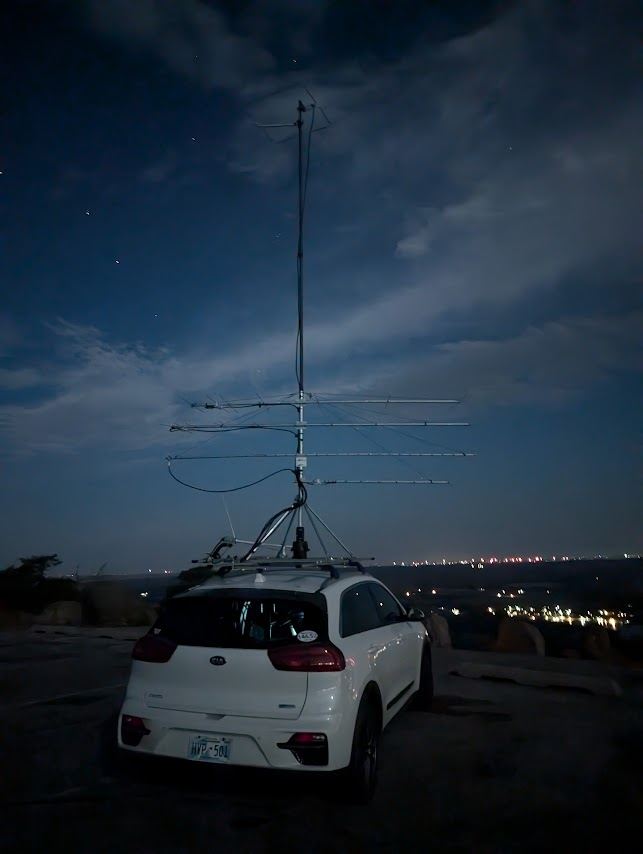
Why all the antennas on your car?
Yes, my car has a few antennas more than normal. Their sole purpose is not to catch bugs on the highway nor to cause people to think it is a government surveillance vehicle. Each antenna has a specific purpose in my electronics hobby called Amateur Radio (see the section above).
Your car likely has two antennas, one for the FM radio and one for the AM radio (usually an AM radio antenna is embedded in the rear window or front window). Likewise your cell phone incorporates multiple antennas within it’s case (5G, 4G, bluetooth, GPS). Each ‘band’ of radio frequencies needs an antenna who’s length is appropriate for the ‘band’ of frequencies it is intended for. Your FM radio receives frequencies from 88.7 to 108.0 MHz (mega Hertz as in 1 million Hertz). Your AM radio receives frequencies from 540 kHz to 1700 kHz (kilo Hertz as in 1 thousand Hertz). These are far apart and require different antennas.
My car has Amateur Radio antennas for 50 Mhz, 144 MHz, 222 MHz, 440 MHz and 1230 MHz.. (and maybe 900 MHz). How many ‘bands’ do Amateur Radio operators get to use? A LOT! Here is a chart: http://www.arrl.org/graphical-frequency-allocations
How many people do this
If your wondering how many people are licensed in the US, you can see the numbers correlated by our association: http://www.arrl.org/fcc-license-counts If you are interested in what it takes to become licensed, you can ask me (a volunteer licensing instructor and examiner).
You can also start here: http://www.arrl.org/licensing-education-training
My favorite study tool is HamStudy.org: https://hamstudy.org/ — free practice exams in the browser, a paid mobile app, and an intelligent Study Mode that tracks which questions you’ve actually mastered instead of just throwing random questions at you. I recommend it to every student in my Tech and General classes.
How can you learn more or get licensed
The national Association (ARRL) publishes a license manual you can buy on Amazon. The team behind HamStudy.org also now publishes their own exam prep books on Amazon — the HamStudy HamBook series — which pair naturally with the practice questions on the site and app. Either book will get you there; pick whichever style fits how you learn but the HamStudy book is easy to read and understand.
Lots of radio clubs offer courses via Zoom for FREE. There are even places where you can take your license exam for FREE, so the only cost is the book and the FCC License fee.
To learn more, go here: https://w5nor.org/ham/
The current edition is the HamStudy Technician License HamBook, 2026–2030 edition. https://www.amazon.com/HamStudy-Technician-License-HamBook-2026/dp/B0GZF6GM2N Each series expires every 4 years, with the Tech being replaced in 2026, the General in 2027 and Extra class in 2028. https://hambook.org/