At college I studied Microwave communications, waveguide, etc. Now, many decades later it’s actually something we can do (without waveguide and tens of thousands of dollars)! I’m really excited to finally experiment with 10 GHz, especially after speaking to one of my mentors and learning how popular, forgiving, and easy 10 GHz contacts can be! Akin to operating via satellites, this is one of those spectacular achievements I’ve wished to accomplish.
Seeding my new obsessive concept/project
I attended the June 2025 Central States VHF Conference and met Kent Britain WA5VJB in person for the first time. His information regarding Cheap Yagi’s for LEO satellites was very helpful to me a couple decades ago. While I had Mr. Britains’ attention I asked “What should I add next?” and he immediately replied with “10 GHz – it reflects off the different air density pockets which are always present and it’s very popular among HAMS. It’s also forgiving! Just get a 10 GHz horn and you can make some contacts because there are always different pockets of air density! Do 10 GHz before you think about any other band. The other bands have more challenges and require direct point-to-point but 10 GHz reflects off the different density air and rain and it’s just easy!”. This hooked me. When I returned home I began my obsessive studying spending countless days reviewing how to get on-the-air on 10 GHz.
Transceiver/Transverter
Obviously the first thing I need is a 10 GHz SSB/FM carrier I could modulate. I looked at the ICOM IC-905 and I looked for transverters. I found that Down East Microwave (DEMI) produces a transverter that will provide 3watts for under $1k. The IC-905 alone is nearly $3k and I would still need the CX-10G at $1k to even have 10GHz at 0.5 Watt! Not to mention in my car I don’t exactly have the space for yet another touch-screen radio.. So I decided to use the DEMI transverter with my IC-9700 on 70cm. I’m assuming if I’m on 10368 I won’t be simultaneously trying to use 70cm.
Antenna
With the ‘transceiver platform’ chosen my next obstacle was the antenna. Kent Britain had strongly suggested I use a horn not a dish – which makes sense from my studies at Oklahoma State. Dishs are complicated with their offset angles, etc.. just using a horn will accomplish the goal without the complexity of a dish and the theoretical additional 10 dB gain if the feed height and angle is exactly as it needs to be. After some digging and a lot of sticker shock I settled on one I found on Ebay from Poland. I then used a 1-gal milk jug and a heat gun to form a horn cover (to keep out insects and gravel road dust).
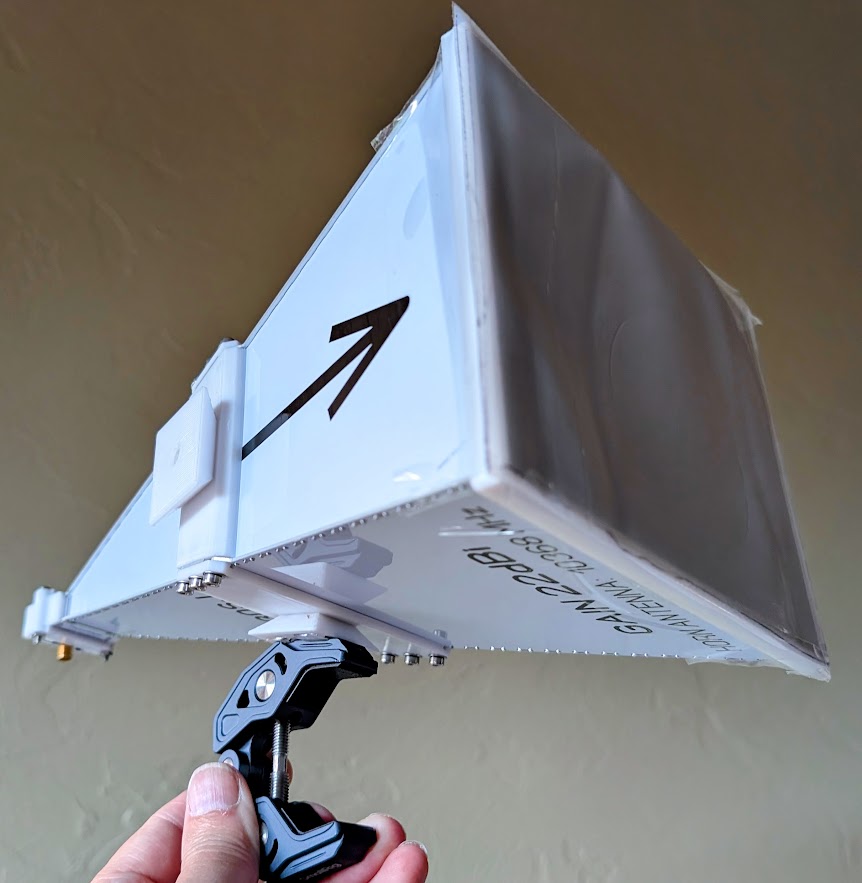
The 10368 MHz horn I will use. This is very thin-wall aluminum and will not survive being fixed to the antenna mast on a moving car. I instead intend to park, quickly clamp it on, and get on the air. When done, unclamp and put it back inside the car.
Transverter Coax Switch
I chose the DEMI 10368-144 assembled transverter. https://www.downeastmicrowave.com/product-p/10368-144.htm With this I simply had a 432 MHz in / 10368 GHz in/out transverter and next I needed a coaxial relay to switch from Trans/Rx even though I only had one radio and one antenna.
This began the problem with finding a coax relay for 10 GHz. After a few days of research and sticker shock I settled on a Teledyne Coax switch, CR-33S10 via Mouser Electronics. This introduced the next problem – this is SMA female and the DEMI 10368-144 is SMA female.. so I needed to eventually figure out how to connect them.
Coax
I spent several more days looking at coax only to eventually land on Times Microwave TCOM-240. The TCOM-400 is better but in my environment I require a lightweight, flexible coax that is rated to 10GHz and capable of mounting to an SMA connector. My antenna is a very flimsy microwave horn therefore I decided lightweight, flexible TCOM-240 was the best solution. This was also the only small coax rated to 10 GHz with only 26.2 dB attenuation per 100/ft which is impressive. All the other coax cables I found that were rated for 10 GHz either had ridiculous attenuation or were too thick or too expensive. Frankly, TCOM-240 is a bargain find.
Also, I had to choose a straight SMA connectors as the 90° connectors de-rated the solution to 6 GHz instead of 10 GHz. I poured through lots of coaxial specifications looking for dB loss / 100 ft for 10 GHz.. I ordered this as a custom assembly from Pasternack.
SMA 90° Elbows
Again I spent many more hours looking at 90° SMA Male/Male adapters. Prices topped out around $200 for what I can describe as a bent 90° pipe. Honestly at that price I could have bought a 1-ft coax with SMA straight male connectors for less cost, although the connector would be more compact, rigid and have less dB loss.. Anyway, via DigiKey I found the connector I needed with an 18 GHz cut-off for merely $11 each, part # ACX1430-ND and this is a connector from Amphenol! I was elated to finally find “a bargain”.
Horn attachment to mast
I was surprised to find that what I assumed would be an easy find was anything but.. I assumed the tripod mount on the horn antenna would be easy. I figured I would find a shoe that I could pipe-clamp or otherwise attach to the mast to allow me to rapidly park, mount the antenna and coax, and get on the air. Nope. I finally realized there is hardly a thing as a “standard” tripod mount. Finally I ran a 3/4 inch stainless steel 1/4-in screw though the mount and into a clamp-on camera base. So no quick shoe mount but I still have a quick mount.
Horizontal mast
As for how/where to attach the horn, I decided it was time to add a horizontal mast to the vertical mast, and place it where I could reach it while standing on the driver side door sill. This meant re-adjusting antennas so I moved the 902 MHz and 432 MHz antennas (both rear-mounts) to the horizontal mast and I left room on the driver side to also attach the horn with it’s clamp-on.
Who, what, when, why
And give the story an ending with a successful contact..